The word “digitisation” suggests a major upheaval: replace the till, retrain the team, migrate data, close for a week. The result: the project gets postponed every year — while the order book, the phone ringing mid-cut and the Saturdays with no room to breathe remain firmly in place.
Our conviction, after experiencing it in our own butcher shop: the upheaval is unnecessary. Your checkout works. What is missing is what happens before checkout.
What your till does very well
The till and approved scales do a regulated, well-established job: weigh, price, take payment, print the receipt and keep the accounts. Your team knows them inside out. Replacing them means weeks of friction to do, at best, just as well. A project that begins with “first we change the till” has a good chance of never getting past that first line.
What it will never do
A till takes payment from the customer standing there. Everything involving a customer who is not there yet falls outside it: the phone order taken during service, the book everyone fills in differently, Saturday’s preparation planned from memory, stock shortages the customer discovers at the counter, and online sales. This is not a fault with your till — it simply is not its job. It is the job of an order-management tool.
The “alongside the till” approach
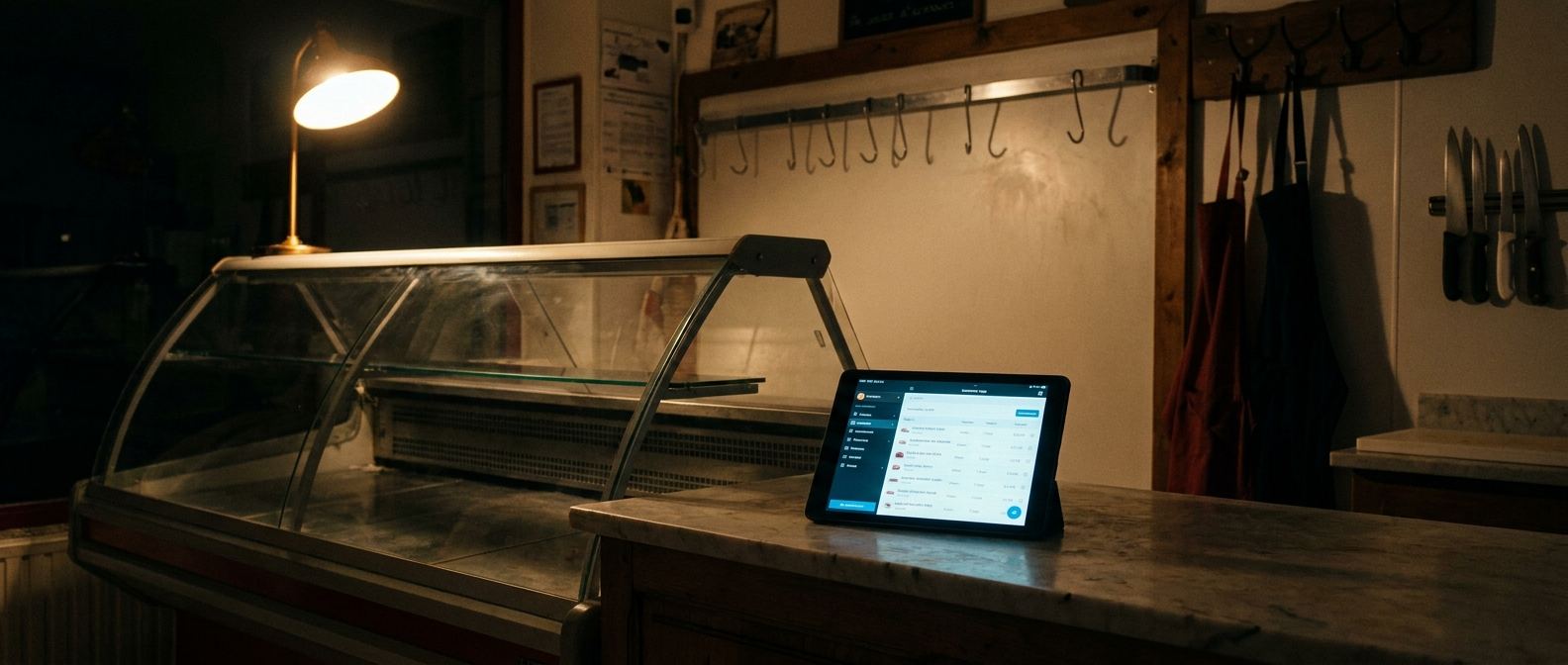
The principle: an order tool that runs alongside your existing setup without touching it. Orders — phone, counter, online — arrive in one place, print as order labels and are prepared department by department; the customer pays at collection on your till, at the scale price, just as today. No migration, no change at checkout, and the team learns a tool that mirrors what they already do — not a new trade.
Where to start: orders, not the website
Instinct says “start with the website, that is what people see”. Experience says the opposite: start with in-store order management. It handles the rush, the team uses it ten times an hour, and it makes Saturdays breathable — we have detailed the method in an article on preparation. Once that process is in place, opening click & collect becomes straightforward: web orders feed into a system that already works.
The checklist before choosing software
- Does it understand your trade? Selling by weight, cuts to order, options (thickness, preparation), an estimated total and payment by actual weight. If the demo only shows fixed-price baskets, be cautious.
- Does it print? An order that does not come out as a label when needed will be copied by hand — and the benefit disappears.
- Does it respect your capacity? Collection slots with a limit per slot, enforced automatically by the tool.
- Do your data remain yours? Customer database, histories, hosting in France and GDPR. See also the pricing-model question.
- Judge it on a real Saturday. Not in a meeting room. A free trial with your catalogue and your team is worth more than any sales pitch.
This is exactly RushPilot’s approach: keep your till and handle everything else — order taking and preparation first, online sales next. Built in a real butcher shop, tested on real Saturdays.