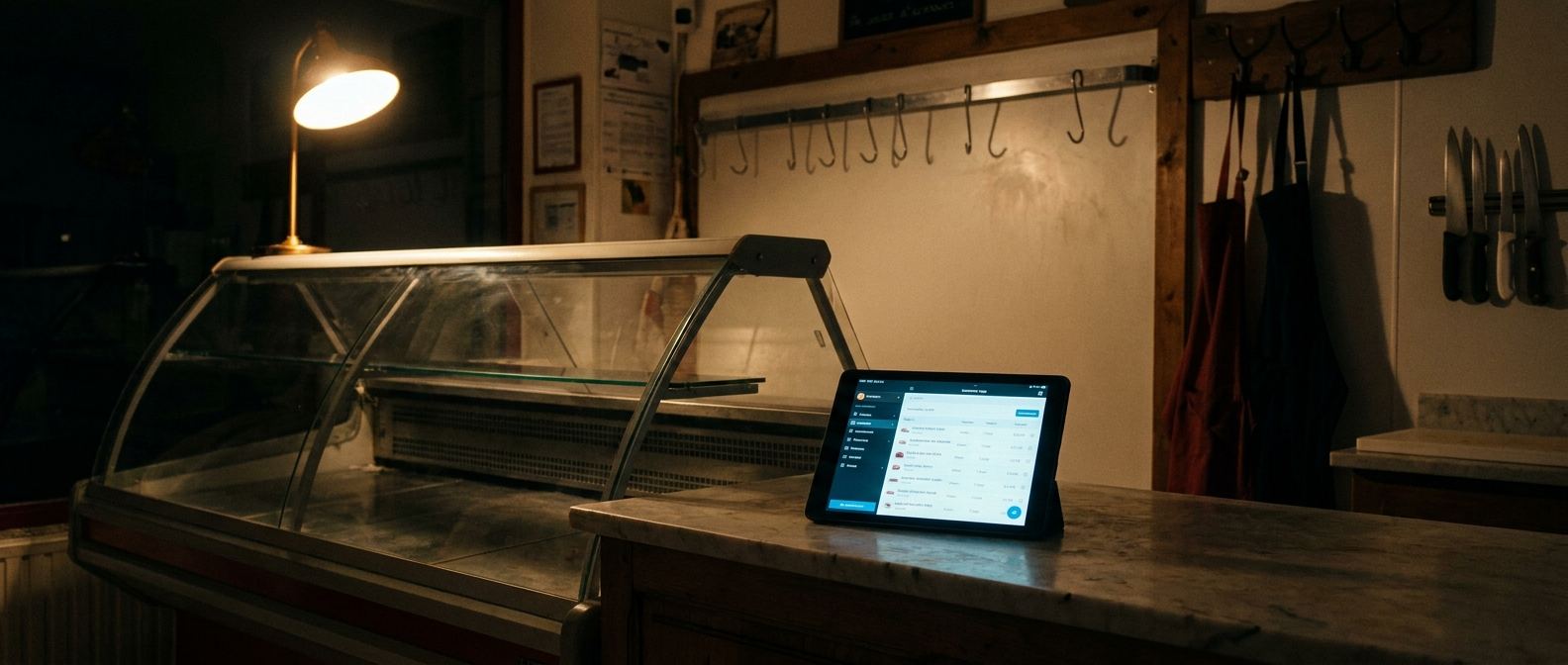
Click & collect is hardly a revolution for a butcher shop. You already do it: a customer calls, orders a roasting joint for Saturday and comes to collect it. Click & collect is exactly that — except the customer orders from their sofa on Tuesday evening, and the phone does not ring while you are in the middle of cutting.
This guide will not sell you a “digital transformation”. It lists what you actually need to decide before getting started, in order, with the mistakes we have made or seen others make. We are butchers, and our online shop handled more than 100,000 orders before we turned it into a tool for other shops.
Before the software: three decisions
1. What you sell online
Everyone wants to “put the whole shop online”. That is a poor starting point. Begin with the essentials: the products your customers already order by phone — roasting joints, poultry, bone-in ribs of beef, weekend dishes and platters. A short, well-maintained selection is better than an exhaustive catalogue with half its items out of stock. You can expand once the process is running smoothly.
2. Your collection slots
This is THE decision that protects your Saturday. A collection slot is a promise: “your order will be ready at this time”. If you accept thirty collections between 10 am and 10:30 am on a busy holiday Saturday, you have just created your own rush. Set a capacity for each slot that your preparation team can actually handle — and choose software that refuses orders beyond that limit, rather than letting you discover the problem on the day.
3. Who prepares orders, and when
An online order does not prepare itself. Decide who processes orders (first thing in the morning? as they come in?), by department if you have several trades under one roof, and how an order is marked as ready. If the answer is “we will see”, click & collect will make you pay for it at 11 am on a Saturday. We have written a dedicated guide to organising order preparation.
The catalogue: where the real work happens
This is where most projects get bogged down. Each product needs a clear name, a price per kilo or per item, a decent photograph, and the options that matter in your trade: chop thickness, preparation (tied, sliced, freshly minced), and the approximate weight of the cut. That is several days of work if you tackle it alone on Sunday evenings — allow for it, or choose a tool that does the groundwork for you. At RushPilot, AI builds the first version of the catalogue and photographs; you make corrections instead of starting from a blank page.
One often overlooked point: stock shortages. Your online catalogue must let you say “no more lamb today, back on Thursday” in ten seconds from the counter. Otherwise you will sell what you do not have, and you will be the one calling to apologise.
Payment: when ordering or after weighing?
Conventional e-commerce takes payment when the order is placed, at a fixed price. But a rib of beef never weighs exactly 1.2 kg. There are two approaches: force standardised weights (and compromise your craft), or embrace payment by actual weight — the customer orders, you weigh during preparation, and they pay the scale price at collection, just as they would at the counter. This is the model we stand behind: no price disputes, no partial refunds to manage, and a fair price for the customer.
Let people know it exists
Your first click & collect customer is someone already visiting your shop. A window poster, a word at the till, a reminder on the bag, the website address on the receipt: these are more effective than any advertisement. Online orders rarely take off in the first week — they take off when your regulars realise they can reserve their Saturday order without calling.
Pitfalls we have seen (or experienced)
- Copying orders by hand. If web orders need copying into the order book, you have added work instead of removing it. The order should print out, ready to follow through preparation.
- Opening the floodgates without capacity limits. Unlimited slots on 23 December, and it is the preparation team that breaks.
- Fixed prices for products sold by weight. At best you lose margin; at worst you lose the customer’s trust.
- Commission that grows with you. A percentage on every basket seems painless at first — do the maths before signing.
How long does it take to get started?
With software designed for the trade, most of the lead time comes from your catalogue and collection-slot decisions — not the technology. At RushPilot, setup is guided by AI and takes days rather than months, with no setup fee. The best approach is to see how the module works or start a free trial and judge it using your own catalogue.